How connecting IT and OT with real-time data can support smarter, more efficient manufacturing
Introduction: Building a More Connected Manufacturing Environment
Manufacturers are under constant pressure to meet production deadlines, maintain quality standards, increase throughput, and respond quickly to changing customer requirements. At the same time, they are expected to operate more sustainably and make better use of resources. Meeting these goals requires timely, reliable information about what is happening across the factory.
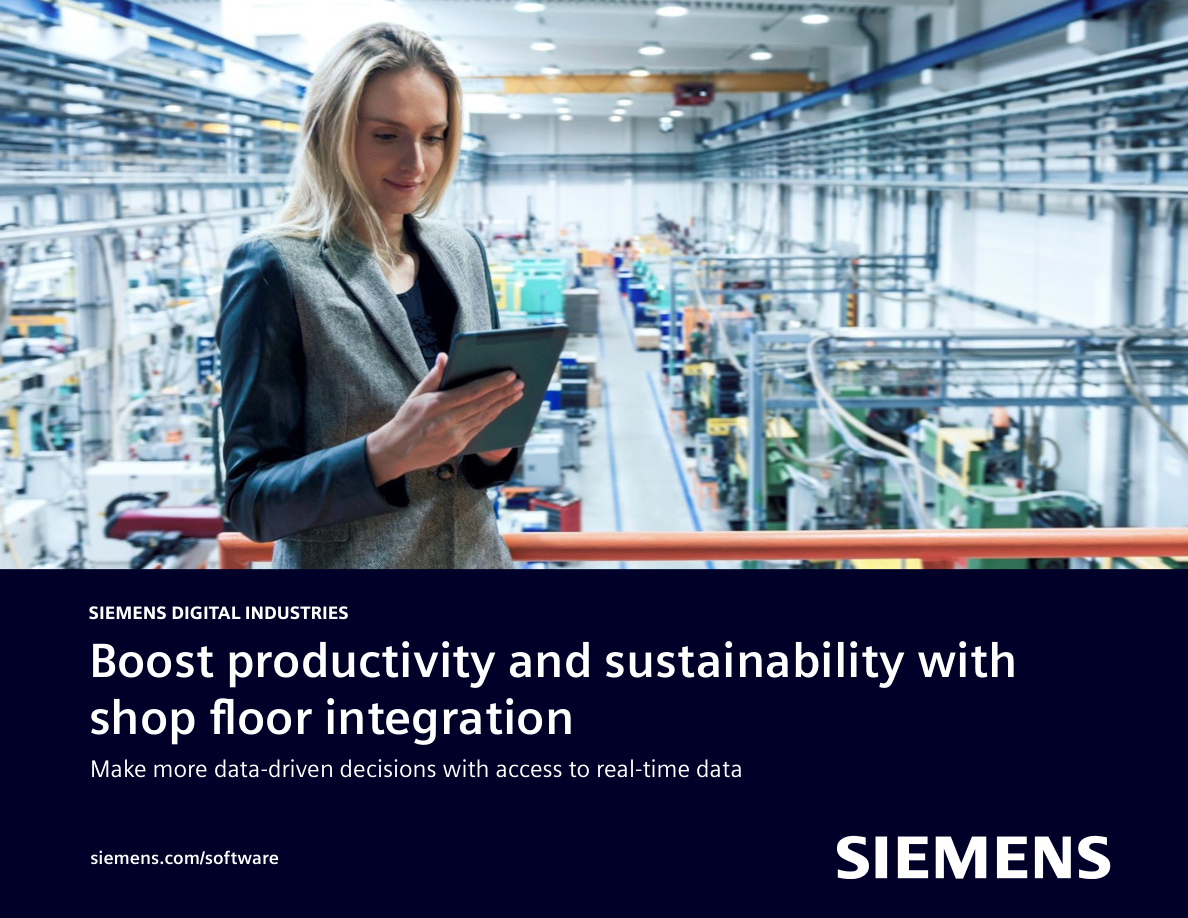
Siemens Digital Industries Software’s guide, “Boost productivity and sustainability with shop floor integration,” explains how connecting information technology (IT) and operational technology (OT) can give manufacturers access to real-time production data. By making operational information more accessible, organizations can make more informed decisions, improve efficiency, increase flexibility, and support more sustainable operations.
1. Understanding the Convergence of IT and OT
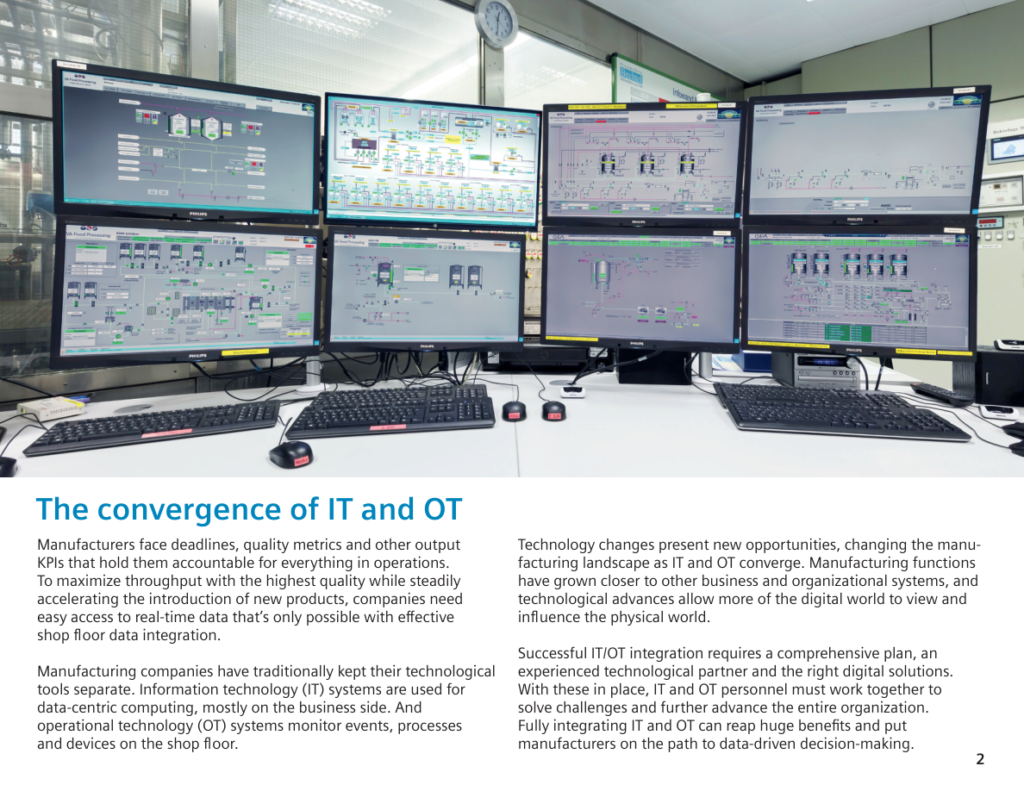
Traditionally, manufacturing organizations have managed IT and OT as separate environments. IT systems have focused mainly on data-centric computing and business functions, while OT systems have monitored and controlled the machines, processes, and devices operating on the shop floor.
As technology evolves, these environments are becoming increasingly connected. IT/OT integration enables business systems and production operations to share information, helping organizations understand how decisions and events in one area affect the other.
The Siemens guide emphasizes that successful integration requires a comprehensive plan, an experienced technology partner, appropriate digital solutions, and collaboration between IT and OT teams. When these elements work together, manufacturers can use operational data to support organization-wide, data-driven decisions.
2. Four Trends Reshaping the Manufacturing Industry
Sustainability
Regulatory requirements and customer demand for greener products are encouraging manufacturers to reduce their carbon footprint. Data generated through IT/OT integration can help organizations monitor production, understand resource consumption, and identify opportunities to move toward CO2-neutral and more sustainable operations.
Mass customization
Customers increasingly expect products tailored to their individual needs. This can lead to smaller production lots and more frequent changes in manufacturing requirements. Connected systems and accessible production data can help manufacturers become more flexible and adapt schedules and processes while maintaining production targets and profit margins.
Supply chain security
Supply chain disruptions can create delays and affect product quality. The guide highlights modularization and standardized interfaces as ways to support more secure and resilient production. A robust IT/OT infrastructure can help manufacturers improve efficiency while responding to supply chain changes.
Digitalization
Industry 4.0 is transforming traditional facilities into smart factories. Digitalizing both direct production and supporting processes enables connected systems and smoother data management. This can improve transparency and help organizations maintain better quality.
3. How IT/OT Integration Creates Opportunities for Improvement
Connecting IT and OT improves connectivity and makes manufacturing data more accessible. With a clearer view of production activity, manufacturers can respond faster, reduce emissions, improve quality, adapt to changing demand, and increase operational efficiency.
Faster processes
Real-time production visibility helps managers identify bottlenecks and make decisions more quickly. A better understanding of production processes can also help organizations fulfill sales orders on demand.
More sustainable operations
Machine data can be used to monitor energy usage and demand. Manufacturers can analyze this information to make better decisions about energy consumption and reduce their overall CO2 footprint.
Improved quality and traceability
Greater access to real-time data, combined with consistent data management, supports product tracking and tracing. A complete production database can help organizations retrieve information for audits and improve visibility across manufacturing processes.
Greater flexibility
Connected data can support just-in-time capabilities and faster responses to change orders or production downtime. Rapid rescheduling becomes easier when IT and OT systems share relevant information. Manufacturers can also build a more complete genealogy of product and process data.
4. Overcoming the Challenges of IT/OT Integration
The guide notes that IT and OT remain disconnected in many organizations because of differences in architecture, technology, and responsibilities. It reports that only one-third of manufacturers claim their IT and OT environments are fully integrated.
Several challenges can hold organizations back: security concerns, diverging priorities or requirements, a mixture of older and newer machinery, and a lack of personnel expertise. These challenges are significant, but the guide presents integration as an achievable journey.
The first step is close collaboration between IT and OT personnel. Teams should identify shared pain points, agree on common objectives, and prioritize projects that are aligned across both functions. The recommended approach is to start small while keeping a larger transformation vision in mind.
Organizations should also consider working with an experienced technical partner who can contribute expertise and help ensure data security. Standardized communication protocols for both existing (brownfield) and new (greenfield) equipment, supported by appropriate sensors and edge devices, are important early building blocks.
5. Practical Use Cases for Shop Floor Integration
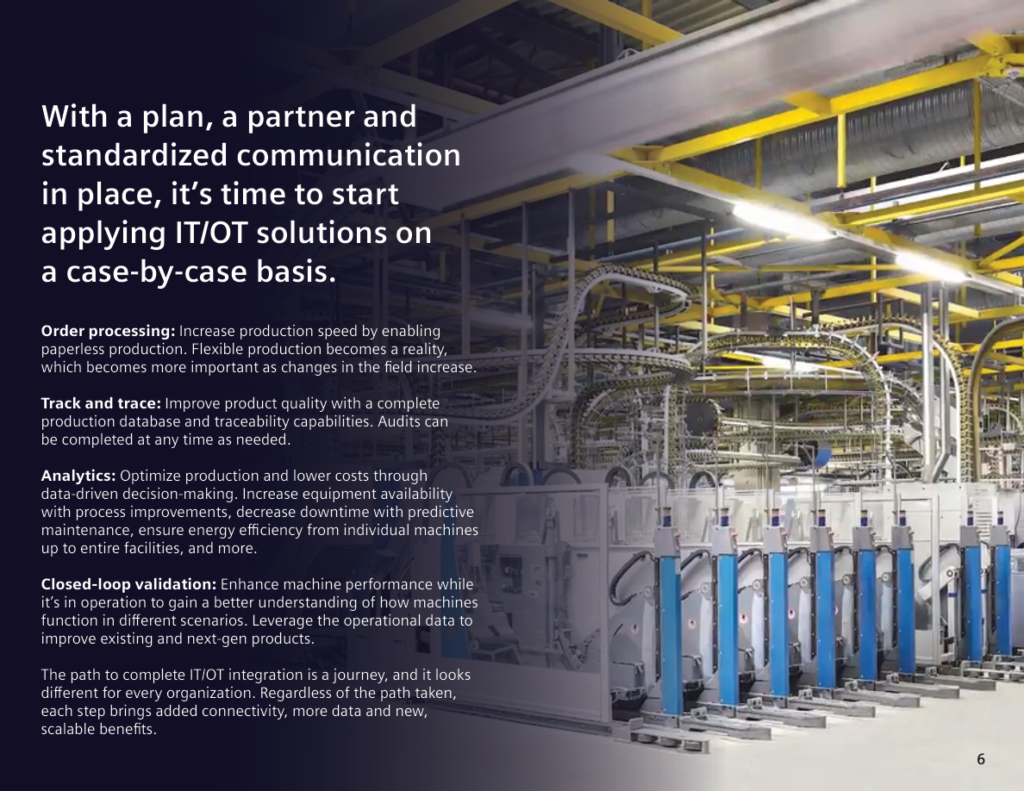
Once a plan, partner, and standardized communication approach are in place, manufacturers can apply IT/OT solutions to selected use cases and expand over time.
Order processing and paperless production
Paperless production can help increase production speed and support more flexible manufacturing. This becomes especially valuable when production requirements change frequently.
Track and trace
A complete production database and traceability capabilities can help improve product quality and make audit information available when needed.
Analytics and predictive maintenance
Data-driven analytics can help optimize production and reduce costs. Process improvements can increase equipment availability, while predictive maintenance can help decrease downtime. Energy efficiency can be considered at the level of individual machines and across entire facilities.
Closed-loop validation
Operational data can be used to understand how machines perform under different operating scenarios. This information can support improvements to machine performance while equipment is running and inform the development of existing and next-generation products.
6. Vorwerk: A Real-World IT/OT Integration Success Story
The Siemens guide presents Vorwerk, a home appliance manufacturer, as an example of an organization working to make its manufacturing processes more reliable, efficient, and flexible.
Before its integration initiative, Vorwerk’s software solutions were not standardized or integrated. Production relied on paper-based processes and manual data reporting, which made it difficult to understand shop floor activity in real time and perform effective analysis.
Vorwerk began by integrating IT and OT operations and standardizing communication protocols. This helped eliminate the existing landscape of isolated software systems. The company then started implementing manufacturing operations management (MOM) solutions to support scheduling, execution, and intelligence.
Although implementation took time, the guide reports that Vorwerk experienced returns from its investments: productivity increased, rework decreased, and material inventory was reduced. The work also established a foundation for Industry 4.0 and future manufacturing improvements.
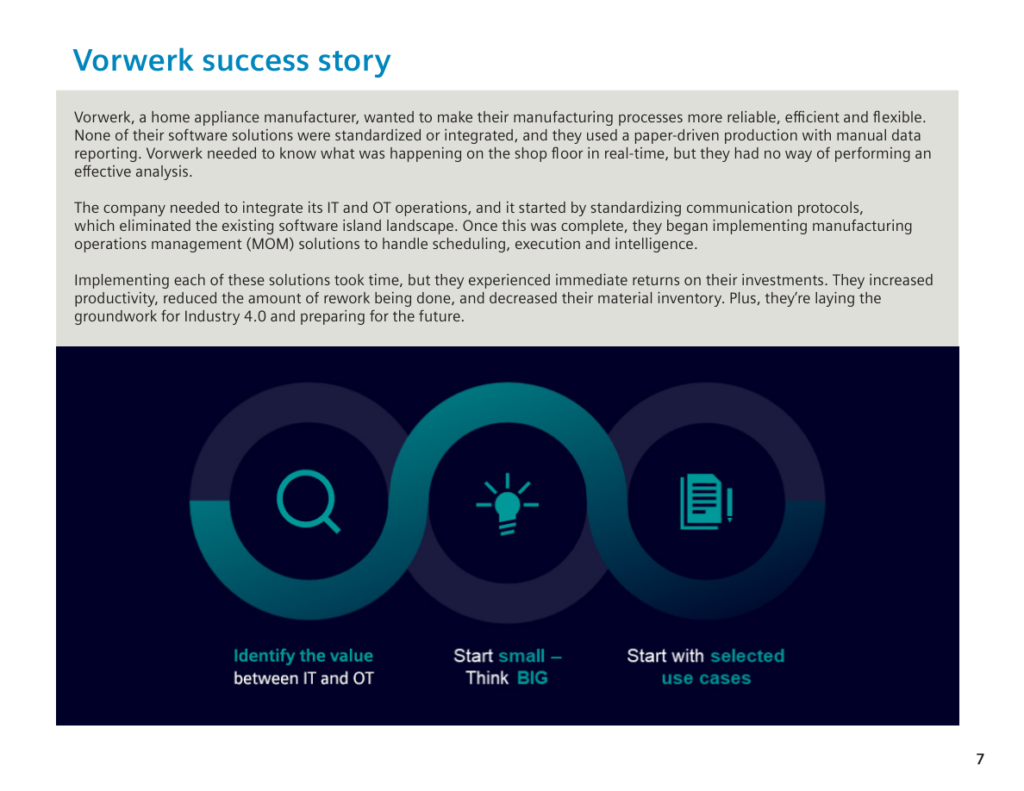
The case illustrates the value of identifying the benefits of IT/OT integration, starting with manageable steps, and selecting use cases that address real operational needs.
7. A Practical Roadmap for Manufacturers
- Assess the current IT and OT landscape, including systems, equipment, communication methods, and security requirements.
- Bring IT and OT teams together to identify shared challenges and agree on priorities.
- Select a small number of high-value use cases that can be delivered with available resources.
- Choose an experienced technology partner where additional expertise is needed.
- Establish secure, standardized communication across existing and new equipment using appropriate sensors and edge devices.
- Introduce solutions for order processing, traceability, analytics, predictive maintenance, or closed-loop validation as appropriate.
- Measure operational outcomes and expand integration incrementally as the organization gains experience.
Conclusion: Make Manufacturing Decisions with Real-Time Data
IT/OT integration brings business technology and shop floor operations closer together, allowing manufacturers to make better use of the data they already generate. The benefits described in the Siemens guide include faster processes, improved quality and traceability, greater production flexibility, more efficient operations, and better visibility into energy use and sustainability.
The journey does not need to happen all at once. By collaborating across IT and OT, addressing security and standardization early, and beginning with selected use cases, manufacturers can build connectivity step by step. Each stage can create more access to data and new opportunities for improvement.
For manufacturers preparing for the future, the central message is clear: connecting the shop floor with enterprise systems helps turn real-time operational data into better decisions—and supports productivity, quality, flexibility, and sustainability.